
The Spectrum of Selves Model for Psychedelic-Assisted Therapy – ACT integrated with Parts work
£330.00
All workshops are held on (Thu-Fri):
2026 Dates:
- 12-13th Nov
9.30 am – 5:00pm
Islington, London
Certificate of attendance:
Provided
Preparatory reading
And
For a peer-reviewed analysis of 3 years of data applying this approach to groups followed by one-to-one psychotherapy: Trajectories of Psychedelic-assisted change (Whitfield et al., 2026)
From Psychedelic Insight to Augmented and Lasting Behaviour Change
Psychedelic experiences can produce profound insight, emotional release and a new view of the self. Insight on its own, however, does not reliably become lasting change.
This two-day introductory training sets out a practical framework for closing that gap, helping clients carry a psychedelic opening through into sustained, values-based behaviour change. Beyond closing the gap we also include methods for building on the initial psilocybin effect.
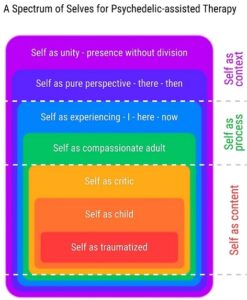
Co-developed by Henry Whitfield, Robert Krause and Larry Leeman and grounded in the peer-reviewed paper A Spectrum of Selves (SoS; Whitfield, 2021, Frontiers in Psychiatry), the SoS model’s application has since been refined through six years of practice. A multi-dataset evidence base is also emergent. First, a longitudinal comparative naturalistic study, Trajectories of psychedelic-assisted change (Whitfield et al., 2026), captures the differential, cumulative and longitudinal effects of different combinations of SoS interventions up to 44 weeks. Significant changes were found across all measures for the long-term follow-up data. Qualitative interpersonal-interaction and idiographic process datasets are also forthcoming.
The training is kept to a small group, with enough practice time that the skills can be integrated, not merely observed. This group experience is held in person in Islington, London.
What this training is for
The approach is built to integrate the parts of a client that want change and the parts that avoid such change; the protector that works through avoidance; the wounded younger self; the self that has to return on Monday morning to work, relationships and ordinary life. The SoS model gives a language and structure to help us find clear pathways through such tensions. We also apply protocols for expanding on the work that began during the psychedelic experience. Our research found that all measures showed greater changes at 8–12 weeks (post-integration) than at 1 week post-psilocybin.
This training will enable you to:
- Prepare clients for psychedelic work through openness, willingness and somatic labelling
- Work directly with parts, protectors, critics, shame and younger self-states, and the conflict between them
- Use somatic parts-work methods to help clients meet feelings in the body
- Respond to intense material during a dosing session without becoming too “non-directive”
- Distinguish when to intentionally target an obstacle to progress and when presence is enough
- Use perspective-switching exercises so clients can move beyond a single, polarised self-state
- Amplify and reinforce psychedelic insights, anchoring them in new self-reinforcing behaviours
- Coach clients toward closer alignment between daily action and a long-term vision for self-care, relationships, community and environment
What is included
Participants receive scripts, worksheets, diagrams, a cross-model integration map and training manual. Teaching is built around demonstration, dyad practice, role play and applied exercise, so the methods are ready to use with clients. Peer supervision and further practical training are available for anyone integrating the model into ongoing practice.
Who should attend
The training suits psychedelic therapists, ketamine clinicians, ACT therapists, IFS and parts-work practitioners, retreat integration therapists, coaches and facilitators who want a structured way to prepare, anchor and build on the effects of psychedelic-assisted sessions. It may also be useful to therapists interested in pathways to deeper psychotherapeutic change.
This training is educational and psychotherapeutic in focus. It does not authorise participants to administer psychedelic substances, or to practise beyond the law or their professional scope.
About the trainer

Henry J. Whitfield PhD Candidate
MSc (CBT), ACBS peer-reviewed ACT trainer, Advanced Traumatic Incident Reduction Trainer,
Henry Whitfield is an Association of Contextual Behavioural Science (ACBS) Peer-reviewed Acceptance and Commitment Therapy trainer, an Accredited Advanced TIR (PTSD therapy) Trainer and Cognitive Behavioural Psychotherapist (MSc – CBT) He is now in the final stages of a PhD in psychedelic-assisted Acceptance and Commitment therapy, looking at interactions between psilocybin experiences and therapeutic processes during and after psilocybin. His research was among the first to capture cumulative effects of therapy and psilocybin.